
AI Chatbot for Website vs Rule-Based Chatbot: What’s the Difference?
Introduction
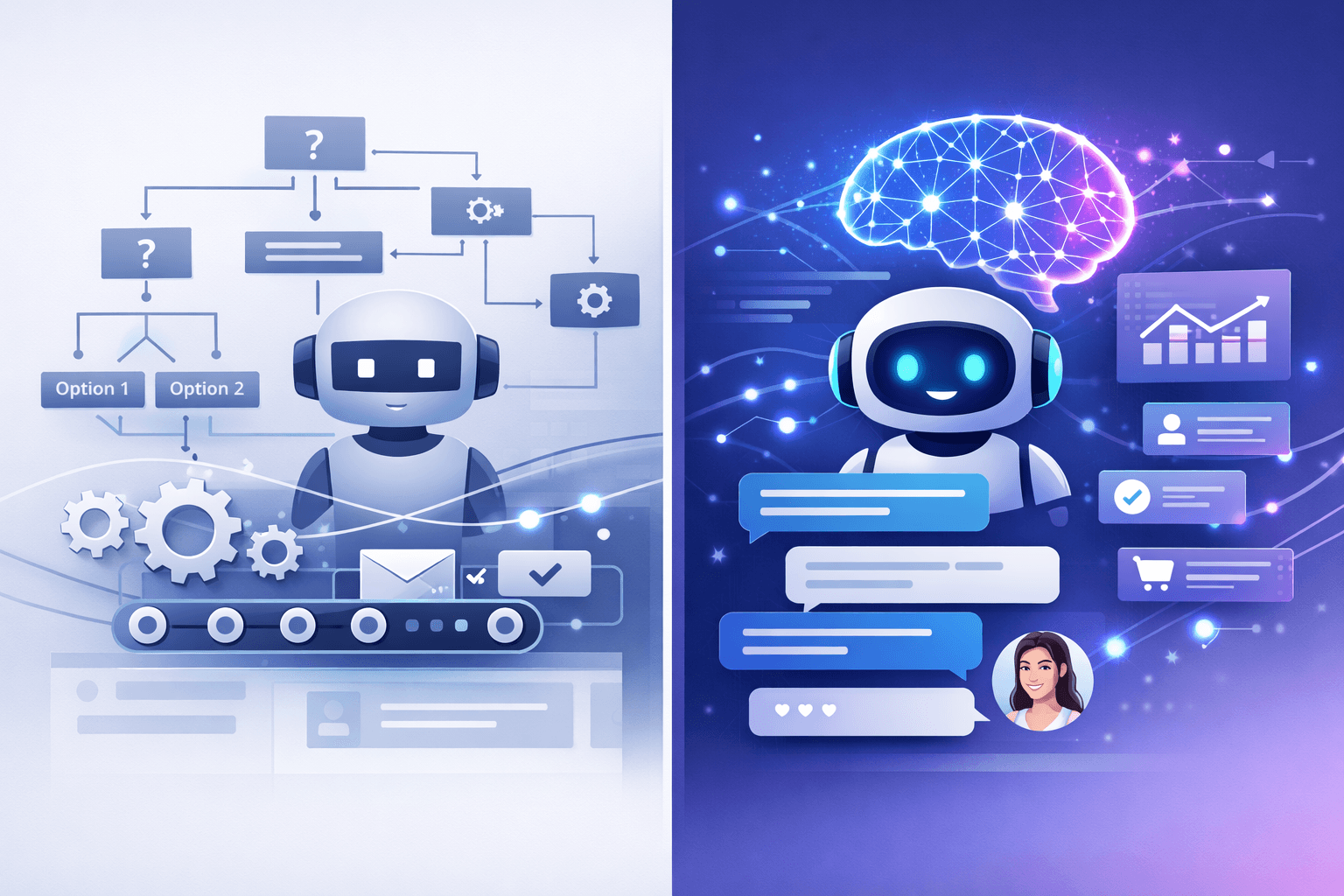
Every business website today has some form of chatbot sitting in the corner of the screen, ready to greet visitors. But not all chatbots are built the same. The difference between an AI Chatbot and a rule-based chatbot is not just a matter of technology it is the difference between a conversation that feels human and a menu that traps users in endless button clicks. For small and growing businesses, choosing the right type of chatbot can directly affect how many leads you capture, how quickly customers get answers, and how much your support team has to manually do every day.
Understanding what separates these two types of chatbots is now a business-critical decision, not just a technical one. As customer expectations shift toward instant, personalized responses, businesses that deploy the wrong chatbot type risk frustrating the very visitors they are trying to convert. This guide breaks down both approaches clearly, explains which one suits different business scenarios, and shows how Aktok's AI-powered platform gives you the right tool for real results.
Most Businesses Are Using Chatbots That Cannot Actually Help
The majority of small business websites today run rule-based chatbots that follow fixed decision trees. On the surface, these look like working automation: a chat widget appears, a greeting message fires, buttons appear on screen. But when a real customer types a question that falls outside the scripted flow, the bot either loops, fails, or offers an irrelevant option. The customer gives up and leaves, and the business never even knows the conversation happened.
The deeper problem is that rule-based chatbots require constant manual maintenance. Every time your product changes, pricing updates, or a new FAQ arises, someone has to go back into the bot builder and rescript the flows. For small teams already stretched across sales, support, and operations, that ongoing effort rarely happens. The result is an outdated bot that actively damages trust with customers who receive wrong or irrelevant information from what they assumed was a live or intelligent system.
AI Chatbots That Understand, Learn, and Respond in Context
An AI Chatbot for website solves the core limitation of rule-based systems by understanding natural language rather than matching keywords to pre-written scripts. Powered by Natural Language Processing (NLP) and Large Language Models (LLMs), an AI chatbot interprets what a customer actually means even when they phrase it differently each time and generates a contextually appropriate response. This means your website can hold real conversations, answer complex questions, and guide visitors through their journey without any scripted flow breaking down.
For businesses that operate across time zones or after business hours, this matters enormously. An AI chatbot does not sleep, does not tire, and does not give inconsistent answers depending on who is handling the chat. It qualifies leads, captures contact details, books appointments, and escalates to Live Chat or a human agent when a conversation genuinely requires personal attention. The result is a 24/7 customer engagement layer that works intelligently without adding headcount.
Key Features of an AI Chatbot for Website
Choosing between an AI chatbot and a rule-based chatbot becomes clearer once you understand what each type can and cannot do. Here are the capabilities that define a genuine AI chatbot:
- Natural Language Understanding (NLU): Interprets free-text input from users without requiring them to click predefined options or rephrase their question.
- Intent Recognition: Instantly identifies what a visitor wants whether that is pricing information, product support, or booking an appointment and routes the conversation accordingly.
- Context-Aware Responses: Remembers previous messages within the same conversation and delivers replies that are relevant to what was said before, not generic template answers.
- Lead Qualification Automation: Asks the right questions, scores responses, and routes high-intent visitors directly to your CRM or sales pipeline without manual intervention.
- Seamless Human Handoff: Transfers to a live agent with full conversation history intact, so the customer never repeats themselves.
- 24/7 Availability Without Scripts: Operates continuously across all hours without requiring pre-written flows for every possible question.
Benefits of Using an AI Chatbot Over a Rule-Based Chatbot
The business case for upgrading from a rule-based chatbot to an AI-powered one is grounded in measurable outcomes that affect both customer experience and operational efficiency. The improvements are consistent across industries and business sizes.
Beyond conversion rates, AI chatbots create a compounding advantage over time. Every conversation generates data visitor intent patterns, frequently asked questions, drop-off points in the conversation that helps businesses refine their messaging, improve product pages, and better understand what customers actually need. A rule-based chatbot generates none of this intelligence. It only executes what it was told, with no learning and no insight, making it operationally expensive and strategically blind.
- Response Time: Instant vs. Delayed: AI chatbots respond in real time with accurate answers; rule-based bots often require multiple clicks before reaching useful information.
- Lead Capture Rate: Up to 3× higher: AI chatbots engage visitors naturally and capture contact details conversationally rather than through rigid form-style menus.
- Support Ticket Reduction: 40–60%: By resolving common questions automatically, AI chatbots dramatically reduce the volume reaching human support agents.
- Maintenance Effort: Near Zero vs. Ongoing: Rule-based bots require constant manual updates; AI chatbots self-adapt to new queries without reprogramming.
AI Chatbot vs Rule-Based Chatbot: Comparison Table
Feature | Rule-Based Chatbot | AI Chatbot for Website |
Response Method | Fixed scripts and decision trees | Natural language understanding and LLMs |
Handles Unexpected Questions | No — breaks or loops | Yes — adapts and responds intelligently |
Personalization | None — same flow for every user | High — context-aware, remembers conversation |
Lead Qualification | Manual or button-click only | Automated with intent detection |
Maintenance Required | High — needs constant rescripting | Low — learns and improves automatically |
After-Hours Operation | Limited by script coverage | Full 24/7 intelligent availability |
CRM Integration | Rarely included | Native integration with CRM and workflows |
Setup Complexity | Simple but rigid | Intuitive visual setup, no coding required |
Who Needs an AI Chatbot and What Role Does It Play
An AI chatbot serves different functions depending on who in your organization is using the output and what goal it needs to achieve. Understanding the role it plays for each team helps you justify the investment and measure the right outcomes.
Across every team listed below, the common thread is speed and context. When a visitor gets an instant, relevant, personalized response at 2 AM, that interaction is as valuable as any handled during office hours and the AI chatbot makes it operationally possible without additional staffing.
Business Owners and Founders: Use the AI chatbot to replace slow, manual first-touch responses and ensure every website visitor is engaged, qualified, and logged into the CRM automatically.
Customer Support Teams: Handle high volumes of repetitive queries automatically, freeing agents to focus on complex issues that actually require human judgment and empathy.
Sales Representatives: Receive pre-qualified leads directly from the chatbot with intent data, conversation history, and contact details already captured, reducing cold outreach and improving close rates.
Marketing Managers: Use chatbot interaction data to understand visitor intent, optimize campaign landing pages, and segment audiences more accurately for follow-up campaigns.
Receptionists and Front-Desk Staff: Automate appointment booking, handle routine inquiries, and reduce interruptions using the Appointment Scheduler integrated with the chatbot flow.
How Aktok Helps Businesses Deploy AI Chatbots That Actually Convert
Aktok is an AI-powered business automation platform that brings together an AI Chatbot, Live Chat, CRM, AI Sales Assistant, Appointment Scheduler, and Project Management in a single connected workspace. Unlike standalone chatbot tools that work in isolation, Aktok connects every chatbot interaction directly into your CRM and sales pipeline, so no lead is ever captured and then lost in a disconnected tool.
When a visitor starts a conversation through Aktok's AI Chatbot on your website, their intent is identified immediately. If they have visited before, the system recognizes them. If they are ready to buy, a trigger routes them to the AI Sales Assistant. If they need human help, the conversation is handed off to Live Chat with full context preserved. No coding is required to set this up Aktok uses visual workflows and drag-and-drop builders that any team member can configure and update without technical support.
Aktok's AI Chatbot is built specifically for small and growing businesses. It requires no server infrastructure, no IT team, and most businesses are fully live within a single day of setup.
Case Study: Converting More Leads with Aktok AI Chatbot
E-Commerce Brand Replaces Rule-Based Bot and Doubles Lead Capture
A growing e-commerce business selling home furnishings had deployed a rule-based chatbot on their website two years prior. The bot handled FAQs reasonably well during setup, but as their product catalogue expanded, the bot's scripts fell behind. Visitors were hitting dead ends asking about new product lines or delivery timelines, and the support team was receiving the same unanswered queries through email that the chatbot was supposed to handle. Lead capture through the chat widget had dropped to near zero because the rigid flow required too many clicks before reaching a contact form.
Switching to Aktok AI Chatbot Delivers Immediate Results
After switching to Aktok's AI Chatbot integrated with the CRM, the business saw immediate improvement in visitor engagement. The chatbot handled free-text questions about delivery, returns, and product specifications without a single scripted update. Lead capture increased because visitors could ask naturally and receive relevant answers. High-intent visitors were automatically routed to the sales pipeline, and the support team's inbound email volume dropped significantly within the first month of deployment.
Lead capture rate increase in Month 1 — 2.4×
Support email volume reduction — 52%
After-hours leads captured (previously zero) — 34% of monthly total
Conclusion
The gap between an AI chatbot and a rule-based chatbot is wider than most businesses realize until they have experienced both. Rule-based bots offer a surface-level presence on your website; they answer scripted questions and nothing more. AI chatbots create genuine conversations, qualify leads intelligently, operate around the clock, and feed every interaction into your CRM and sales workflow automatically. For businesses serious about converting website traffic into customers, the choice is clear.
Aktok brings everything your business needs into one connected platform — AI Chatbot, Live Chat, CRM, AI Sales Assistant, Appointment Scheduler, and Sales Tools without the complexity of managing multiple tools or the expense of enterprise software.
Try Aktok for free today and see how an AI chatbot transforms your website from a brochure into a 24/7 lead generation engine.
Frequently Asked Questions
What is the main difference between an AI chatbot and a rule-based chatbot? A rule-based chatbot follows fixed decision trees and can only respond to questions it was specifically scripted to handle. An AI Chatbot uses Natural Language Processing and Large Language Models to understand free-text input, interpret intent, and generate contextually relevant responses even for questions it has never been explicitly programmed to answer. The practical difference is that AI chatbots hold real conversations while rule-based bots navigate users through button menus.
Can an AI chatbot replace my human support team? No, it is not designed to. An AI chatbot handles high-volume, repetitive queries automatically so your human team can focus on complex issues that require empathy, judgment, and nuanced understanding. Aktok's AI Chatbot includes a seamless handoff to Live Chat so customers are transferred to a human agent with full conversation context whenever a situation requires personal attention.
Is an AI chatbot suitable for small businesses with limited budgets? Absolutely. Platforms like Aktok are designed specifically for small and growing businesses, with scalable pricing and no infrastructure requirements. The return on investment comes quickly through increased lead capture, reduced support volume, and after-hours engagement that would otherwise require additional staffing. Visit Aktok Pricing to see plans built for businesses of every size.
Does Aktok's AI Chatbot integrate with my existing CRM and tools? Yes. Aktok's AI Chatbot connects natively with the Aktok CRM, Appointment Scheduler, Live Chat, and Sales Tools within a single platform. Every chatbot interaction is automatically logged to the relevant customer profile, so your sales and support teams always have full context without manual data entry or tool switching.
How long does it take to set up Aktok's AI Chatbot on a website? Most businesses live within a single day. Aktok's chatbot is configured through visual workflows and drag-and-drop builders with no coding or developer involvement required. The platform's Help Center provides guided onboarding, and a free trial is available so you can experience the setup and functionality before committing to a paid plan.

Helping thousands of small businesses succeed every day
Get 24/7 access to Aktok's AI Chatbot that automates Customer support, captures leads, and manages conversations
Learn More