Benefits of Using a Digital Workspace Platform for Remote and Hybrid Teams
Introduction
The way teams work has fundamentally changed. Remote work is no longer a temporary arrangement, it has become a permanent fixture for millions of businesses worldwide. Hybrid work models, where employees split time between the office and home, have become the new standard for companies ranging from small startups to large enterprises.
This shift has created a challenge that no amount of video calls or email threads can solve on its own: how do distributed teams stay connected, aligned, and productive when they are not in the same room?
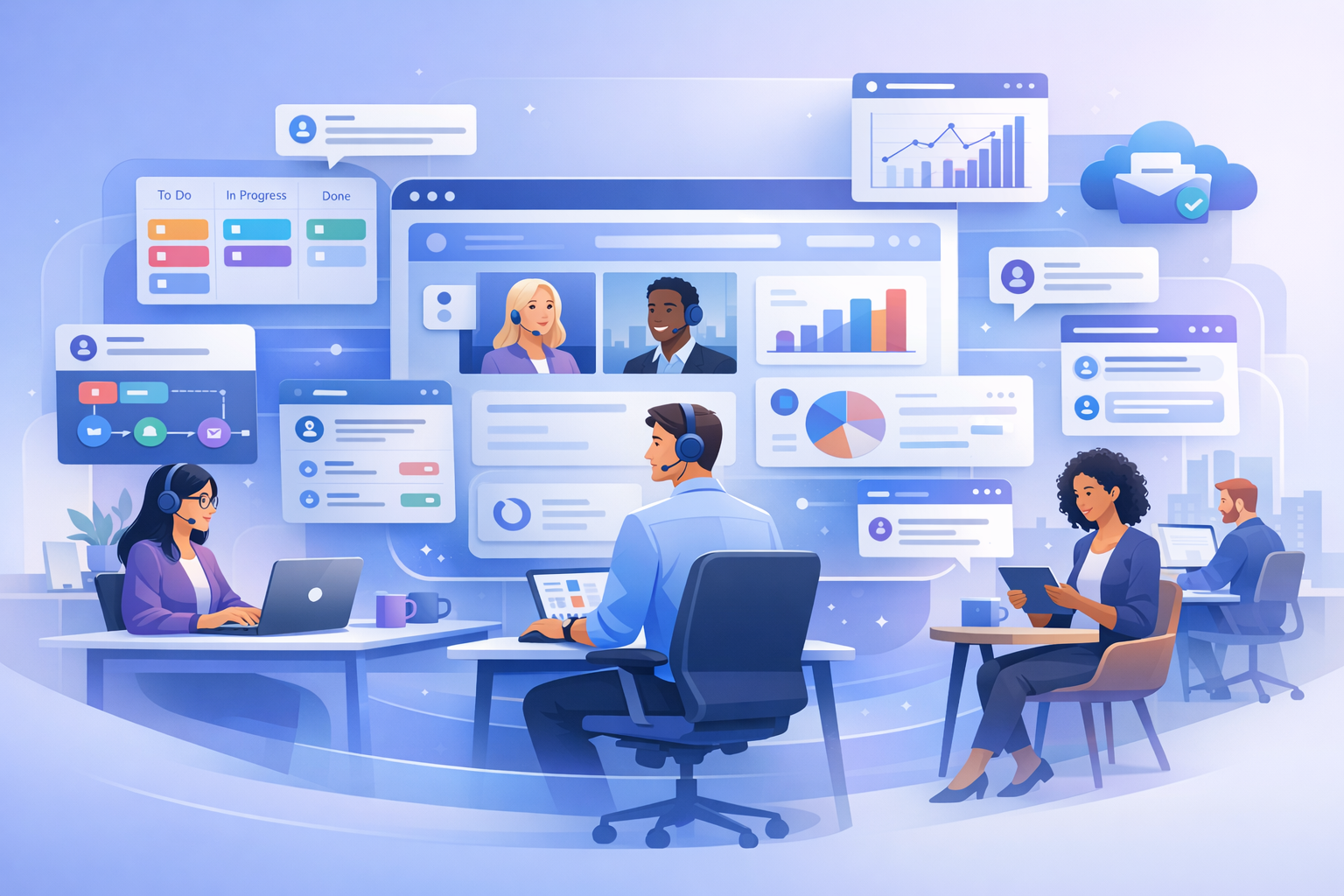
The answer lies in digital workspace platforms. A digital workspace platform brings together project management, communication, customer data, file storage, and automation into a single unified environment. For remote and hybrid teams, this is not a luxury it is the infrastructure that makes everything else work.
In this article, we explore the key benefits of using a digital workspace platform for remote and hybrid teams and why businesses that adopt one gain a significant operational advantage.
Everyone Works from the Same Source of Truth
One of the most damaging problems in remote work is information fragmentation. When one team member updates a document, another sends a conflicting version by email, and a third makes decisions based on outdated data, projects stall and mistakes become expensive.
A digital workspace platform eliminates this problem by creating a single source of truth. Every task, file, update, and conversation lives in one place. When a change is made, everyone sees it immediately regardless of where they are working from.
This is particularly important for hybrid teams, where office-based employees and remote workers often develop separate information flows. A shared workspace breaks down that divide and keeps the entire team operating from the same reality.
Communication Becomes Structured and Contextual
Remote teams often overcommunicate in the wrong places. Endless message threads, back-and-forth emails, and scattered Slack conversations create noise without clarity.
A digital workspace platform replaces scattered communication with structured, contextual conversations. Instead of discussing a project update in a general chat channel, teams comment directly on tasks, files, or client records. Every piece of communication is attached to the work it relates to.
This contextual approach means that when a new team member joins a project, or when someone needs to revisit a decision made three weeks ago, the full context is right there. No digging through inboxes. No chasing down colleagues for information.
For hybrid teams especially, where not everyone is in the building to ask a quick question, structured communication is what keeps work moving without constant interruption.
Project Visibility Across the Entire Team
In a traditional office, a manager can walk the floor and quickly assess how projects are progressing. In a remote or hybrid environment, that casual oversight disappears and without a replacement system, projects can drift off track without anyone noticing until the deadline arrives.
Digital workspace platforms give managers and team leads real-time visibility into every project. Dashboards show which tasks are complete, which are in progress, and which are overdue. Workload views reveal whether team members are stretched too thin or have capacity to take on more.
This visibility is not about micromanagement. It is about informed leadership. When managers can see what is happening across the team from a single screen, they can make better decisions, offer support where it is needed, and identify risks before they become problems.
Accountability Is Built Into the Workflow
Accountability is harder to maintain when teams are distributed. When a task is mentioned verbally in a meeting or buried in an email, ownership becomes ambiguous. People assume someone else is handling it. Things fall through the cracks.
A digital workspace platform removes this ambiguity entirely. Every task has an assigned owner, a deadline, and a visible status. Team members know exactly what they are responsible for, and their progress is transparent to the rest of the team.
This level of accountability does not require uncomfortable conversations or constant follow-ups from managers. The structure of the platform makes ownership clear from the moment a task is created.
Onboarding New Team Members Is Faster
Onboarding a remote employee is significantly more challenging than onboarding someone in person. When knowledge lives in people's heads, in email chains, or in documents stored across five different platforms, getting a new hire up to speed takes weeks.
A digital workspace platform dramatically shortens this process. New team members can log in and immediately see active projects, understand how work is structured, access relevant files, and review historical conversations. The workspace itself becomes a living record of how the organization operates.
For hybrid teams where new employees may only be in the office a few days a week, this self-service access to organizational knowledge is invaluable.
CRM and Customer Data Stay Connected to Daily Work
Remote teams serving clients face a specific challenge: keeping customer information connected to the work being done. When CRM data lives in a separate system from project tasks and team communication, important context gets lost between departments.
A digital workspace platform with built-in CRM functionality solves this by connecting customer records directly to projects, tasks, and conversations. Sales teams can see what the delivery team is working on for a client. Support teams can access the full history of a customer relationship without asking a colleague to forward an email thread.
This connection between customer data and operational work is what allows remote and hybrid teams to deliver a consistent, informed client experience regardless of who is handling the account on any given day.
Automation Reduces Administrative Overhead
Remote work introduces administrative friction that office environments often handle informally. Sending status updates, chasing approvals, reassigning tasks when someone is unavailable these small actions accumulate and eat into productive time.
A digital workspace platform with workflow automation handles much of this overhead automatically. Tasks move between stages based on predefined rules. Reminders are sent without manual intervention. Notifications go out when deadlines approach or when a task is waiting for input.
For hybrid teams managing complex workflows across multiple time zones, automation is what keeps operations running smoothly even when key people are offline.
Collaboration Happens in Real Time and Asynchronously
One of the practical realities of remote and hybrid work is that not everyone is available at the same time. Team members work across different time zones, different schedules, and different peak productivity windows.
A digital workspace platform supports both real-time collaboration and asynchronous work equally well. A team member in one location can leave a detailed comment on a task at the end of their day. A colleague in a different time zone picks it up at the start of theirs, responds, and moves the work forward all without a single meeting.
This asynchronous capability is one of the most underappreciated benefits of digital workspace platforms. It allows teams to make progress around the clock without requiring everyone to be online simultaneously.
Security and Access Control Protect Sensitive Information
Distributed work introduces security considerations that centralized office environments manage more easily. When employees access company data from home networks, personal devices, and public spaces, controlling who sees what becomes critical.
A digital workspace platform provides role-based access controls that allow administrators to define precisely what each team member, department, or external collaborator can view or edit. Sensitive client data, confidential financial information, and internal strategic documents can be protected while still allowing the right people to access what they need.
For businesses managing multiple clients or working with external partners, this granular control over access is essential for both security and professional trust.
It Reduces the Cost and Complexity of Running Multiple Tools
Most remote and hybrid teams today are running a painful stack of disconnected tools. A project management app here, a CRM there, a messaging platform, a scheduling tool, a file storage service. Each tool costs money. Each tool requires training. And none of them talk to each other without custom integrations.
A digital workspace platform consolidates this complexity into a single subscription. Teams work from one environment, and data flows between functions naturally without manual data entry or third-party connectors.
The cost savings are real, but the bigger benefit is simplicity. When your team only needs to learn one system and managers only need to check one place, operational efficiency improves across the board.
Why This Matters More Now Than Ever
The shift to remote and hybrid work is permanent. Businesses that treat it as a temporary accommodation will continue to struggle with disconnected tools, inconsistent processes, and teams that feel isolated despite working together.
A digital workspace platform is not just a productivity tool. It is the foundation on which modern distributed teams are built. It replaces the informal infrastructure of the physical office, overheard conversations, shoulder taps, and shared whiteboards with a structured digital environment that scales.
Teams that work inside a unified workspace are more aligned, more accountable, and more capable of delivering consistent results regardless of where individual members are located.
Conclusion
Remote and hybrid work comes with genuine challenges, but none of them are insurmountable when teams have the right infrastructure in place.
A digital workspace platform addresses the core problems of distributed work: fragmented information, unclear accountability, disconnected customer data, time-zone friction, and administrative overhead. By bringing everything into a single environment, it gives remote and hybrid teams the same operational clarity that office-based teams have always had and often better.
Whether your team is fully remote, partially distributed, or managing a hybrid model, investing in a digital workspace platform is one of the highest-leverage decisions you can make for productivity, collaboration, and long-term growth.
The businesses winning in the remote work era are not the ones with the most tools. They are the ones that have replaced tool sprawl with a unified workspace where every team member, regardless of location, can do their best work.
Ready to bring your remote or hybrid team into one unified workspace? Explore how Aktok's all-in-one platform with CRM, project management, live chat, AI chatbot, and team workspace helps distributed teams work smarter. Try it free today.