
AI CRM Software vs Traditional CRM: What's the Difference?
Introduction
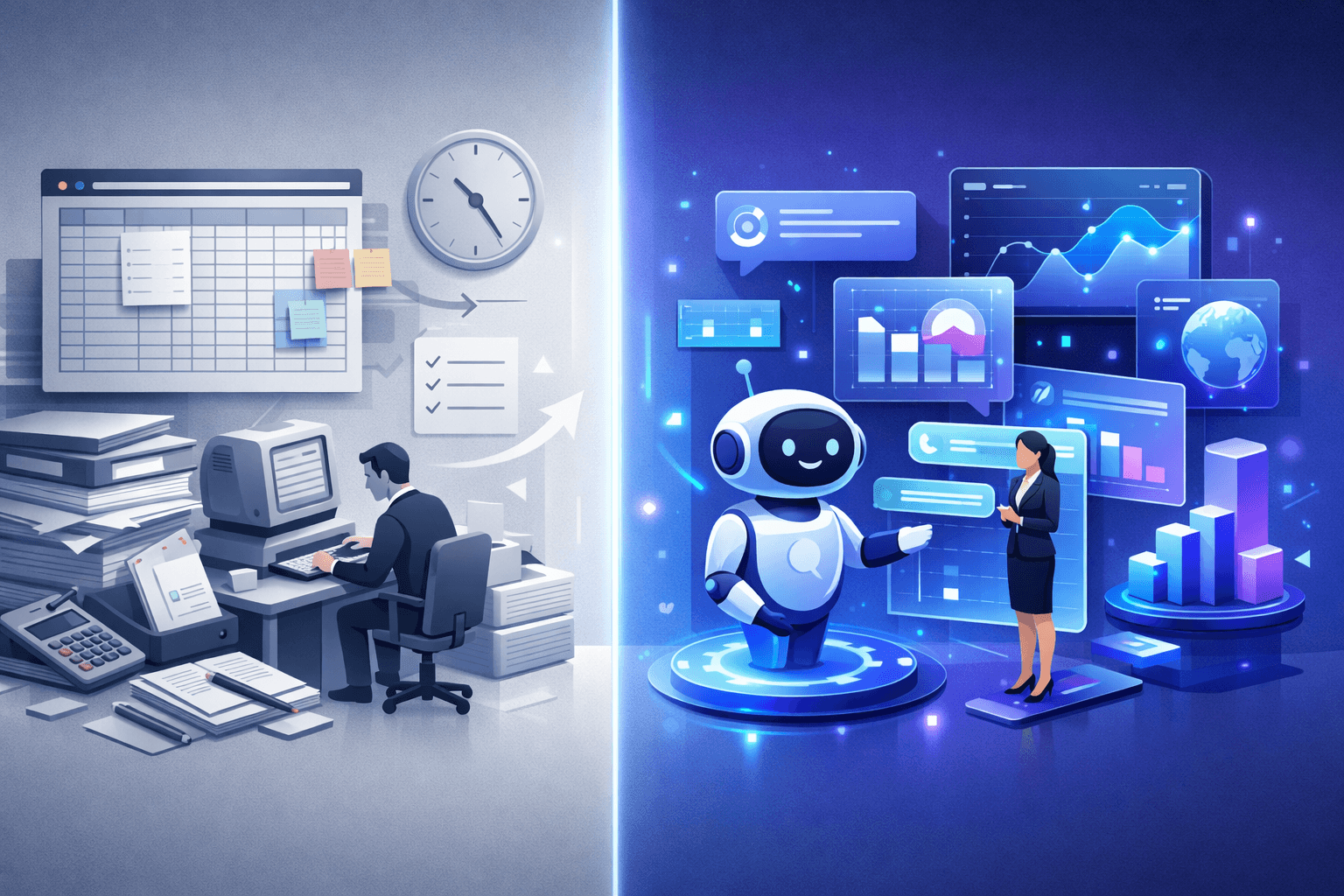
Managing customer relationships has always been at the heart of business growth. For years, traditional CRM systems served as the central hub for storing contact information, tracking sales pipelines, and logging communication history. They were reliable, structured, and built for a world where business moved at a slower pace. But the world has changed customers expect instant responses, personalized engagement, and seamless experiences across every channel, and traditional CRM systems were simply not designed to deliver any of that automatically.
AI CRM software represents a fundamental shift in how businesses manage customer relationships. Rather than acting as a passive database that teams must manually update and query, an AI-powered CRM actively analyzes data, predicts customer behavior, automates routine tasks, and surfaces insights that help sales, marketing, and support teams act faster and smarter. This article breaks down exactly what separates AI CRM from traditional CRM, why that difference matters, and how platforms like Aktok are making AI-powered relationship management accessible to businesses of every size.
Why Traditional CRM Is No Longer Enough
Traditional CRM systems were built to store, not to think. Sales reps spend an average of 65% of their time on non-selling activities including manual data entry, updating contact records, logging call notes, and assembling weekly pipeline reports. Every hour spent maintaining the CRM is an hour not spent closing deals or building customer relationships. The system that was supposed to support the sales process ends up consuming it instead.
The problem runs deeper than productivity loss. Traditional CRM operates reactively: it tells you what happened after the fact. It cannot warn you that a high-value account is about to churn, recommend the right moment to reach out to a lead, or personalize a follow-up message based on a customer's behavioral signals. In a competitive market where timing and personalization directly influence conversion rates, relying on a passive data repository means making decisions based on yesterday's information while your competitors with AI-driven systems are already acting on today's.
AI CRM Software That Works for You
AI CRM software bridges the gap between data and action. Instead of waiting for a sales rep to log a note, update a stage, or trigger a follow-up, an AI CRM monitors every customer interaction in real time across email, chat, forms, and sales pipelines and uses that data to automate the right action at the right moment. It does not replace human judgment; it amplifies it by removing the manual work and delivering the context teams need to make better decisions faster.
For businesses that have outgrown spreadsheets and basic contact managers, an AI-powered CRM platform provides the operational backbone to scale customer relationships without scaling headcount proportionally. The automation handles routine touchpoints welcome sequences, follow-up reminders, re-engagement campaigns, and feedback requests while the AI surfaces predictive insights that help teams prioritize where their time creates the most value. To understand the foundational technology behind modern CRM tools, our guide on cloud-based CRM software covers the core concepts in depth.
Key Features of AI CRM Software
Effective AI CRM goes far beyond a smarter contact database. The features that drive measurable outcomes are tightly connected to the real operational challenges businesses face in managing customer relationships at scale.
- Predictive Lead Scoring The AI analyzes behavioral signals email opens, website visits, form submissions, chat interactions to score leads automatically and surface those most likely to convert, so sales teams prioritize effort where it matters most.
- Automated Workflow Triggers When a contact reaches a pipeline stage, misses a follow-up window, or takes a specific action, the CRM fires the next step automatically with no manual reminders, no dropped balls.
- AI Chatbot and Live Chat Integration Customer inquiries are captured and responded to in real time, with every conversation automatically linked to the CRM contact record giving your team full context without any manual data transfer.
- Intelligent Sales Pipeline Management Visual Kanban-style pipeline views with AI-powered deal health indicators help sales teams identify stalled opportunities and take corrective action before deals go cold.
- Behavioral Segmentation and Personalization The AI groups contacts by their actual behavior, purchase history, engagement patterns, lifecycle stage enabling marketing campaigns that are targeted by real signals, not arbitrary list segments.
- AI Sales Assistant Surfaces the next best action for each deal, recommends outreach timing, identifies upsell opportunities, and drafts personalized follow-up messages helping small teams operate with the sophistication of an enterprise sales organization.
- Real-Time Reporting Dashboards Pipeline health, conversion rates, response times, and campaign performance are visible in real time assembled automatically, not compiled manually at the end of the month.
Benefits of Switching to AI-Powered CRM
The business case for replacing a traditional CRM with an AI-powered platform is grounded in outcomes that directly affect revenue, retention, and team efficiency. The shift is not incremental, it is structural.
Beyond the headline metrics, AI CRM creates a compounding advantage over time. Every customer interaction feeds the system's intelligence, making each subsequent campaign smarter, each follow-up more timely, and each sales conversation better informed. Businesses that adopt AI CRM early build a customer intelligence advantage that competitors still relying on manual processes and static databases cannot easily replicate regardless of how much they invest in headcount.
Metric | Impact |
Time saved on manual data entry per week | Up to 10 hours per rep |
Improvement in lead-to-close conversion rate | +29% on average |
Reduction in customer churn through proactive re-engagement | Up to 25% |
Faster response time with automated follow-ups | 60% reduction |
AI CRM vs Traditional CRM
Many businesses underestimate the operational gap between managing customer relationships with a traditional CRM and doing so with an AI-powered one. The difference is not just a matter of features, it is the difference between a system that records history and one that actively shapes outcomes.
The table below compares both approaches across eight core operational dimensions. Each factor has a direct effect on customer lifetime value, sales team efficiency, and the quality of decisions your business makes every day.
Factor | Traditional CRM | AI CRM Software |
Data Entry | Manual, time-consuming, error-prone | Automated, real-time, AI-assisted |
Lead Scoring | Manual, based on rep judgment | AI-driven, behavior-based, continuously updated |
Follow-Up Automation | Rule-based or manual reminders | Intelligent triggers based on customer behavior |
Personalization | Generic templates, list-based | Dynamic, behavior-driven content and timing |
Reporting | Manually assembled, backward-looking | Real-time dashboards, predictive analytics |
Churn Prevention | Reactive, after the customer leaves | Proactive, AI flags at-risk accounts early |
Team Efficiency | High admin burden, low selling time | Low admin burden, more time on high-value work |
Scalability | Requires proportional headcount increase | Scales customer relationships without adding staff |
Who Needs AI CRM Software
AI CRM software delivers value across every role that touches customer relationships from founders making strategic decisions to frontline team members handling daily customer interactions. Understanding which roles benefit most helps businesses prioritize implementation and set clear success metrics from day one.
Across every function, the common thread is access to better context at the right moment. When a sales rep knows a lead's full engagement history before picking up the phone, or a support agent can see a customer's purchase record the moment a chat opens, every interaction becomes more effective. Aktok's CRM platform is designed to make that context available to everyone across the organization regardless of team, channel, or location.
Founders and Business Owners gain real-time visibility into pipeline health, customer retention trends, and revenue forecasts without waiting for manual reports enabling faster, better-informed strategic decisions.
Sales Teams Spend less time on admin, more time selling. AI-powered lead scoring, deal health alerts, and automated follow-ups mean reps always know who to contact, when, and with what message.
Marketing Teams Move beyond batch-and-blast campaigns. Behavioral segmentation and automated nurture sequences powered by the AI Sales Assistant allow marketers to deliver the right message to the right contact at the right time automatically.
Customer Support Teams Resolve issues faster with full customer context available inside the same platform. Live Chat integrated with CRM means support agents never have to ask a customer to repeat themselves.
Operations and Project Managers Use Project Management integrated with CRM data to align delivery timelines with customer expectations and proactively manage client relationships through every project phase.
How Aktok Helps Businesses Make the Shift
Aktok is an AI-powered business automation platform that brings CRM, AI Chatbot, Live Chat, AI Sales Assistant, Appointment Scheduling, Sales Tools, and Project Management together in one connected workspace. For businesses making the transition from traditional CRM, this unified architecture means customer data does not live in isolated silos — every interaction across every channel is connected to a single, continuously updated customer profile.
When a prospect engages with Aktok's AI Chatbot on your website, that conversation is immediately logged to their CRM record. When a deal moves to a new pipeline stage, the next task is automatically assigned and the relevant team member is notified. When a customer has not engaged in a set number of days, a re-engagement workflow fires automatically without anyone having to remember to check. Aktok's AI Sales Assistant continuously monitors pipeline health, surfaces stalled deals, identifies high-probability opportunities, and recommends the next best action giving even small sales teams the operational intelligence of a much larger organization.
Aktok is built specifically for small and growing businesses. There is no hardware to install, no IT department required, and teams can be fully operational within a day making it the ideal platform for businesses ready to graduate from traditional CRM to AI-powered relationship management.
Case Study: From Manual Follow-Ups to Automated Growth
How a 12-Person B2B Services Firm Closed 34% More Deals After Switching to AI CRM
A B2B professional services firm with a 12-person team had been using a traditional CRM for three years. Their sales pipeline was managed through a combination of manual spreadsheet updates, calendar reminders, and email threads, a system that worked when the team was small but had become a significant drag on performance as the business grew. Leads were falling through the cracks between follow-up cycles, deals were stalling in the pipeline without anyone noticing, and the marketing team had no visibility into which campaigns were actually producing qualified opportunities.
From Manual Follow-Ups to Automated Growth
After migrating to Aktok's AI CRM and AI Sales Assistant, the firm automated their entire lead nurture workflow for the first time. Behavioral triggers replaced manual reminders, ensuring every lead received a timely follow-up regardless of where the sales rep's attention was focused. The AI Chatbot on their website captured and qualified inbound inquiries around the clock, feeding directly into the CRM pipeline without any manual handling. Within 90 days, the team had full visibility into deal health across their entire pipeline, marketing could attribute campaign performance to actual closed revenue, and the sales team reported spending significantly more time on actual selling. The results across the first quarter were measurable and immediate.
Increase in deal close rate in Q1 → +34%
Leads lost to missed follow-up → reduced to zero
Hours saved per week on manual pipeline management → 14 hrs
Time to qualify and route inbound leads → reduced from 48 hrs to under 2 hrs
Conclusion
The gap between traditional CRM and AI CRM is no longer a matter of preference, it is a matter of competitive positioning. Businesses that continue to manage customer relationships through manual data entry, static pipelines, and reactive follow-up processes are operating at a structural disadvantage against competitors whose AI-powered systems are scoring leads, triggering outreach, and preventing churn automatically.
AI CRM software does not replace the human relationships at the center of great customer experience, it creates the operational foundation that makes those relationships possible at scale. By eliminating the administrative burden that consumes sales and marketing teams, delivering real-time visibility into every customer relationship, and automating the routine touchpoints that too often fall through the cracks, AI CRM transforms how businesses grow. Aktok brings everything your team needs: CRM, AI Chatbot, Live Chat, AI Sales Assistant, Sales Tools, and workflow automation into one platform built for teams that need results without complexity.
Ready to See the Difference AI CRM Makes?
Try Aktok for Free : No IT setup, no complexity. Get your entire team working from one connected AI-powered workspace from day one.
Frequently Asked Questions
1. What is the main difference between AI CRM and traditional CRM?
Traditional CRM is a passive system that stores data that your team enters manually and generates reports based on historical records. AI CRM is an active system that analyzes behavioral data in real time, automates follow-ups and workflows, scores leads intelligently, and surfaces predictive insights that help teams act before opportunities are lost. The fundamental difference is between a system that records what happened and one that actively helps shape what happens next.
2. Is AI CRM software suitable for small businesses?
Absolutely. AI CRM is not exclusively for enterprise organizations in fact, small businesses often benefit most because the automation compensates for limited headcount. A four-person sales team using Aktok's CRM and AI Sales Assistant can manage a customer pipeline that would otherwise require a team twice the size. Aktok is designed from the ground up for small and growing businesses, with scalable plans that expand as the organization grows.
3. How does AI CRM improve lead conversion rates?
AI CRM improves conversion rates by ensuring the right action happens at the right time for every lead. Predictive lead scoring surfaces high-priority opportunities so sales reps focus their attention where it creates the most value. Automated follow-up sequences ensure no lead goes cold due to a missed touchpoint. Behavioral personalization means every communication is relevant to where the contact actually is in their buying journey not where a generic template assumes they are.
4. How does Aktok's AI CRM connect with other customer channels?
Aktok brings CRM, AI Chatbot, and Live Chat together in a single connected platform. Every customer interaction whether it starts on your website chat, through a support ticket, or inside a sales pipeline is automatically linked to the relevant CRM profile. Your team always has full context without any manual data transfer between tools, and every automated workflow has access to the same unified customer record.
5. How long does it take to migrate from a traditional CRM to Aktok?
Most businesses using Aktok's cloud-based platform are fully operational within one to two days. There is no hardware to install, no dedicated IT resource required, and contact data can be imported directly from existing CRM exports. Aktok's Help Center provides

For More Details
Aktok CRM is built specifically for small business teams who want powerful sales tools without the complexity of enterprise software.
For More Details