
Customer Relationship Management Software for Grocery Stores
Introduction
The grocery retail industry runs on repeat visits, basket size, and shopper loyalty. A customer who fills their cart at your store this week has a dozen competing supermarkets, discount chains, and online delivery platforms ready to take their business next week. The grocery stores that keep those customers coming back are not always the ones with the lowest prices, they are the ones with the best systems for recognizing shoppers, personalizing offers, and staying relevant between visits.
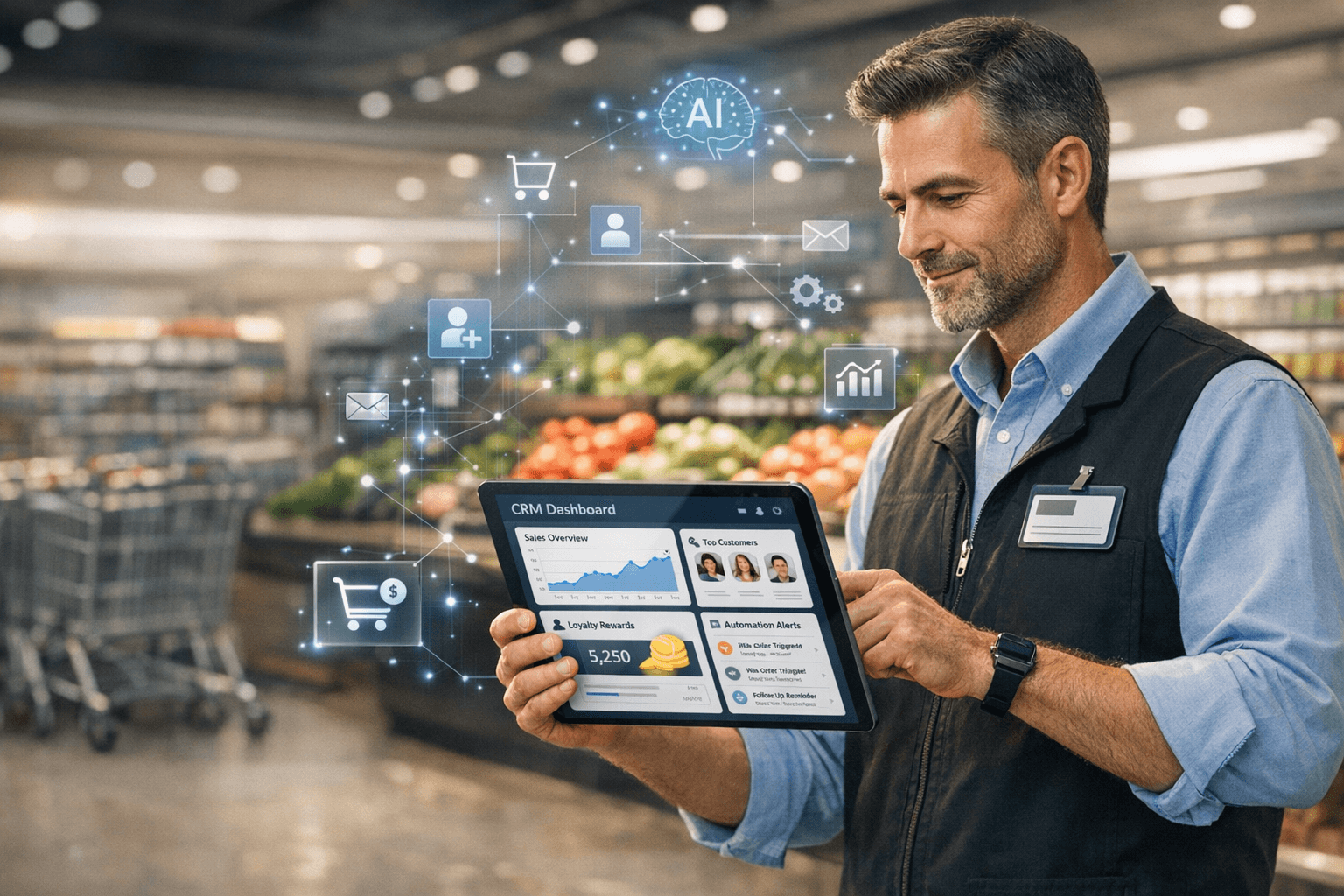
Customer Relationship Management (CRM) software has become one of the most critical tools for grocery retailers looking to compete beyond shelf price and store location. By centralizing shopper data, automating targeted promotions, and enabling personalized engagement at scale, CRM software gives grocery store operators the infrastructure to convert casual buyers into loyal regulars without adding headcount or complexity to daily operations. This article explains why grocery stores need CRM, which drives real outcomes in retail, and how Aktok's integrated platform delivers exactly that.
Grocery Stores Are Losing Shoppers They Could Have Kept
Grocery retail has one of the highest customer switch rates of any consumer industry. Research consistently shows that retaining an existing shopper costs five to seven times less than acquiring a new one, yet most grocery stores still invest the majority of their marketing budget in leaflet campaigns and generic discount ads while doing almost nothing to systematically re-engage shoppers who have stopped coming in. Without a dedicated system, every checkout transaction is effectively anonymous; a shopper who visits three times a week receives the same generic experience as a first-time visitor, and a lapsed customer who switched to a competitor last month receives no win-back communication because no one knows they left.
The challenge compounds for grocery stores with multiple branches or an online ordering channel. When a shopper buys in-store on some visits and online on others, there is no unified view of their purchase history, preferences, or lifetime value. Promotional offers are sent to the entire mailing list rather than the customers most likely to respond. Feedback submitted after a poor experience disappears without being actioned, and the store misses the opportunity to recover the relationship. Without a CRM system, the shopper knows the store but the store does not know the shopper.
CRM Software Built for Grocery Retail Operations
CRM software for grocery stores closes the data gap at the heart of customer retention in retail. Rather than treating every purchase as a standalone transaction, a CRM captures and connects shopper interactions across channels, locations, and time building a unified customer profile that makes personalization, re-engagement, and loyalty programme management operationally achievable for teams of any size.
For grocery retailers specifically, the most effective CRM solutions integrate with order management workflows, e-commerce platforms, and in-store communication tools. They automate routine communication tasks that would otherwise require dedicated staff welcome messages, post-purchase feedback requests, weekly offer alerts, and win-back campaigns while giving marketing and operations teams real-time visibility into which shoppers are most valuable, which are at risk of churning, and which promotions are actually lifting basket size. For a deeper understanding of the underlying technology, our guide on cloud-based CRM software covers the foundational concepts in detail.
Key Features of CRM Software for Grocery Stores
Effective CRM for grocery stores goes far beyond a contacts database. The features that drive real outcomes in grocery retail are tightly connected to the pace, volume, and seasonal nature of the industry. Here is what to look for in a platform built to support retail growth.
Unified Shopper Profiles Every customer gets a single record capturing purchase history, product preferences, loyalty points, and contact details, accessible by every team member and every store location in real time.
Automated Marketing Campaigns Loyalty rewards, seasonal promotions, and win-back sequences run automatically based on shopper behavior, a lapse in visits, a birthday, or a first online order without requiring manual execution from your team.
AI Chatbot and Live Chat Integration Captures shopper enquiries in real time, responds to product availability questions, collects post-purchase feedback, and routes complaints to the right team member automatically.
Visual Pipeline for Bulk and Corporate Orders Gives operations and sales teams a clear pipeline view for catering orders, corporate account management, and wholesale accounts that standard POS systems do not handle well.
Workflow Automation and Smart Triggers When a new loyalty member is registered, an onboarding sequence begins automatically. When a shopper's visit frequency drops, a re-engagement campaign fires without anyone needing to intervene manually.
Real-Time Dashboards and Reporting Repeat visit rates, campaign performance, average basket size, and shopper feedback sentiment are visible in real time not assembled manually at the end of the month.
Benefits of Using CRM in Your Grocery Store
The business case for CRM software in grocery retail is grounded in measurable outcomes that directly affect revenue and operational efficiency. Below are the four core benefits operators consistently see after implementation.
Beyond the headline numbers, CRM creates a structural advantage that compounds over time. Every shopper interaction becomes a data point that improves the next promotion, refines the next product recommendation, and deepens the store's understanding of what keeps customers loyal. Grocery retailers that invest in CRM early build a customer intelligence advantage that competitors running generic flyer campaigns and anonymous till data simply cannot replicate.
Metric | Outcome |
|---|---|
Retention vs Acquisition Cost | 5–7× cheaper to retain an existing shopper |
Repeat Visit Rate | +21% with personalized loyalty triggers and offers |
Time Saved per Week | 10+ hrs through workflow automation and campaign scheduling |
Complaint Resolution Time | Down to under 4 hrs with centralized feedback management |
With CRM vs Without CRM: Grocery Store Comparison
Many grocery retailers underestimate how much customer lifetime value they are leaving on the table without a dedicated CRM system. The difference is not just technical — it is the difference between a store that reacts to customers and one that builds relationships with them proactively across every visit and every channel.
The table below illustrates the contrast across seven key operational areas. Each factor directly affects shopper loyalty, marketing return on investment, and the day-to-day efficiency of your retail team.
Factor | Without CRM | With CRM Software |
|---|---|---|
Shopper Retention | Reactive, no re-engagement system | Proactive, automated win-back campaigns |
Marketing Personalization | Generic flyers and mass email blasts | Behavior-triggered, segment-specific offers |
Feedback Management | Scattered, untracked, unresolved | Centralized, assigned, and actioned |
Multi-Location Visibility | Siloed data per branch | Unified shopper view across all stores |
Team Efficiency | Manual follow-ups, missed tasks | Automated workflows, zero missed reminders |
Loyalty Programme | Paper-based or manual stamp card | System-managed with automatic CRM triggers |
Customer Data Ownership | Lost after each transaction | Captured, stored, and fully actionable |
Who Needs CRM Software in a Grocery Store
CRM software serves multiple roles within a grocery retail operation from the owner making strategic decisions to the customer service team handling complaints and the marketing manager planning the next campaign. Understanding which roles benefit most helps stores prioritize implementation and measure impact accurately.
Across every role listed below, the common thread is access to shopper context. When the right person has the right information at the right time, decisions are better, responses are faster, and customers leave with a stronger reason to return. Aktok's CRM platform is designed to make that context available to everyone who needs it, regardless of the channel or store location they are working from.
- Store Owners & Multi-Branch Operators: Gain shopper intelligence that drives marketing spend decisions, stock planning insights, and retention strategy without relying on guesswork or manually assembled reports.
- Marketing & Promotions Managers: Segment the customer base, design targeted weekly deals, and measure the return on every campaign accurately by tying marketing activity directly to basket and visit data.
- Customer Service & Floor Teams: Resolve complaints faster, recognize returning loyalty members, and maintain service consistency using Live Chat integrated with the CRM shopper record.
- Wholesale & Corporate Sales Teams: Manage high-value bulk orders and institutional accounts using Aktok's sales tools and pipeline views a capability that standard POS systems simply do not provide.
How Aktok Helps Grocery Stores Manage Customer Relationships
Aktok is an AI-powered business automation platform that brings CRM, AI Chatbot, Live Chat, AI Sales Assistant, appointment scheduling, sales tools, and project management together in a single connected workspace. For grocery stores, this integration matters because shopper relationships do not exist in a single channel they span in-store visits, online orders, loyalty app interactions, and social media enquiries.
When a shopper starts a conversation through Aktok's AI Chatbot on the store's website, that interaction is immediately connected to their CRM profile. If they have purchased before, the system recognizes them. If they have a pending complaint about a product, the team is automatically flagged. If they have not visited in four weeks, a re-engagement trigger fires automatically sending a personalized offer without any manual effort from your team. Aktok's AI Sales Assistant helps grocery retail teams identify their highest-value shoppers, surface upsell opportunities on related product categories, and prioritize outreach to accounts most likely to respond enabling even small store teams to operate with the sophistication of a much larger retail chain.
Aktok's platform is built for small and growing businesses. There is no server to maintain, no IT team required, and new users can be onboarded in minutes making it the ideal first CRM for independent grocery stores and growing supermarket chains alike.
Case Study: Increasing Repeat Visits with Aktok CRM
Three-Branch Grocery Chain Reduces Churn and Boosts Loyalty Programme Engagement
A three-location grocery store group was struggling with disconnected customer data across branches and no visibility into which shoppers were visiting regularly versus quietly switching to a competitor. Their marketing team was sending the same weekly promotional email to their entire contact list with no segmentation, and feedback collected from in-store complaint slips was never reviewed systematically — leaving service issues unresolved and loyal customers unrecognized.
How Aktok CRM Transformed Their Customer Retention
After implementing Aktok's CRM and AI Chatbot, the group centralized shopper profiles across all three locations for the first time. Automated re-engagement campaigns reactivated lapsed customers within 45 days. Feedback collected through Aktok's Live Chat integration was assigned directly to store managers with resolution tracking, and personalized loyalty promotions triggered automatically by the CRM drove a measurable uplift in repeat visit frequency within the first quarter of implementation.
Result | Outcome |
|---|---|
Lapsed shoppers reactivated within 45 days | 20% |
Increase in repeat visit rate in Q1 | 21% |
Average complaint resolution time (down from 72 hrs) | Under 5 hrs |
Conclusion
The grocery retail industry is more competitive than ever, and shopper loyalty is no longer something that happens by accident. It is the result of deliberate, data-driven relationship management recognizing customers, responding to them personally, and staying connected between visits in a way that makes your store the obvious choice the next time they need to restock. Without the right infrastructure, even the best product selection and the most convenient location cannot compensate for the anonymous, transactional experience that quietly drives shoppers to try the store down the road.
CRM software makes this level of relationship management possible for grocery businesses of every size. By centralizing shopper data, automating communication, and connecting every customer touchpoint into a single operational picture, CRM transforms a high-volume, margin-sensitive business into one that competes on relationship quality as much as on price and convenience. Aktok brings everything your grocery store needs CRM, AI Chatbot, Live Chat, AI Sales Assistant, and workflow automation into one connected platform built for teams that need results without complexity.
Ready to turn every shopper into a loyal customer?
Try Aktok for Free . No IT team needed. Get started in minutes.
Frequently Asked Questions
What is CRM software for grocery stores?
CRM (Customer Relationship Management) software for grocery stores is a digital platform that captures shopper data, automates marketing and communication, and gives retail operators visibility into customer behavior, purchase patterns, and retention metrics. It connects purchase history, loyalty activity, feedback, and contact information in a single system accessible by your entire team replacing spreadsheets and anonymous POS data with a unified, actionable customer record.
How does CRM help grocery stores increase shopper loyalty?
By tracking individual shopper behavior how frequently they visit, what products they buy, when they last came in a CRM system enables grocery stores to run personalized loyalty programs, targeted weekly promotions, and automated re-engagement campaigns that keep customers returning without requiring manual effort from the marketing team. The result is higher retention rates and increased average basket size driven by personalization rather than mass discounting.
Can CRM software work for small or single-location grocery stores?
Absolutely. CRM is not only for large supermarket chains. Independent grocery stores benefit from CRM by gaining the ability to recognize returning shoppers, run birthday and loyalty reward campaigns, track feedback systematically, and build a marketing database they actually own. Platforms like Aktok are designed specifically for small and growing businesses, with scalable plans that grow alongside operations without requiring IT infrastructure or technical staff.
How does Aktok's CRM integrate with grocery store customer service channels?
Aktok connects CRM, AI Chatbot, and Live Chat in one unified platform. Shopper interactions from any of these channels are automatically logged to the relevant CRM profile, so your team always has full context — whether they are responding to a product complaint, following up on a bulk order enquiry, or running a re-engagement campaign. No manual data transfer between tools is required.
Is it difficult to set up CRM for a grocery store?
With a cloud-based CRM like Aktok, setup requires no hardware installation and no dedicated IT team. Most stores are operational within a day. Aktok's platform is designed to be intuitive for non-technical retail teams, with onboarding support available through the Help Center and a free trial available to get started without any upfront commitment.

For More Details
Aktok CRM is built specifically for small business teams who want powerful sales tools without the complexity of enterprise software.
For More Details