
How to Track Team Performance Without Micromanaging
Introduction
Tracking team performance has become one of the most important challenges for managers in professional services firms. As teams grow larger and work increasingly happens across multiple locations and time zones, managers need reliable ways to know if work is moving forward without interrupting people every hour to ask. When project management is handled without a clear system, problems surface too late, and deadlines get missed before anyone realizes there is an issue.
The good news is that modern business automation platforms make it possible to stay informed without hovering. The key is shifting from activity-based oversight to results-based tracking using smart tools that surface the right information automatically. This guide walks through the core challenges managers face when trying to track performance, and shows practical, proven methods to get the visibility you need while giving your team the independence they need to do their best work.
Why Traditional Performance Tracking Fails Teams
Most managers default to one of two extremes: they either check in constantly, sending messages, requesting updates, and sitting in status meetings, or they pull back entirely and only discover problems when deadlines are already missed. Both approaches fail. Constant check-ins create pressure and signal distrust, which reduces motivation and leads to high-performing employees disengaging. Complete hands-off management leaves problems hidden until they become crises. Neither approach is sustainable in a growing team.
The root cause is almost always the same: there is no reliable system to show progress clearly. When managers lack a structured way to see what is happening, they feel compelled to ask directly. Team members then feel watched rather than supported. Performance measurement becomes unclear because people are judged on how active they appear, quick replies, and long hours, rather than on the results they actually deliver. Accountability breaks down when task ownership is vague, and workflow automation is absent. Stress increases, morale falls, and the team's best work suffers.
Smart Performance Tracking Without Micromanagement
The answer is a structured, systems-driven approach to performance visibility. Rather than relying on manual updates and reactive check-ins, managers need a framework built on three pillars: clear goals, automated progress tracking, and real-time dashboards. When these are in place, managers always have an accurate picture of what is happening without ever having to ask. Team members work independently, knowing that their results are visible and their contributions are recognized.
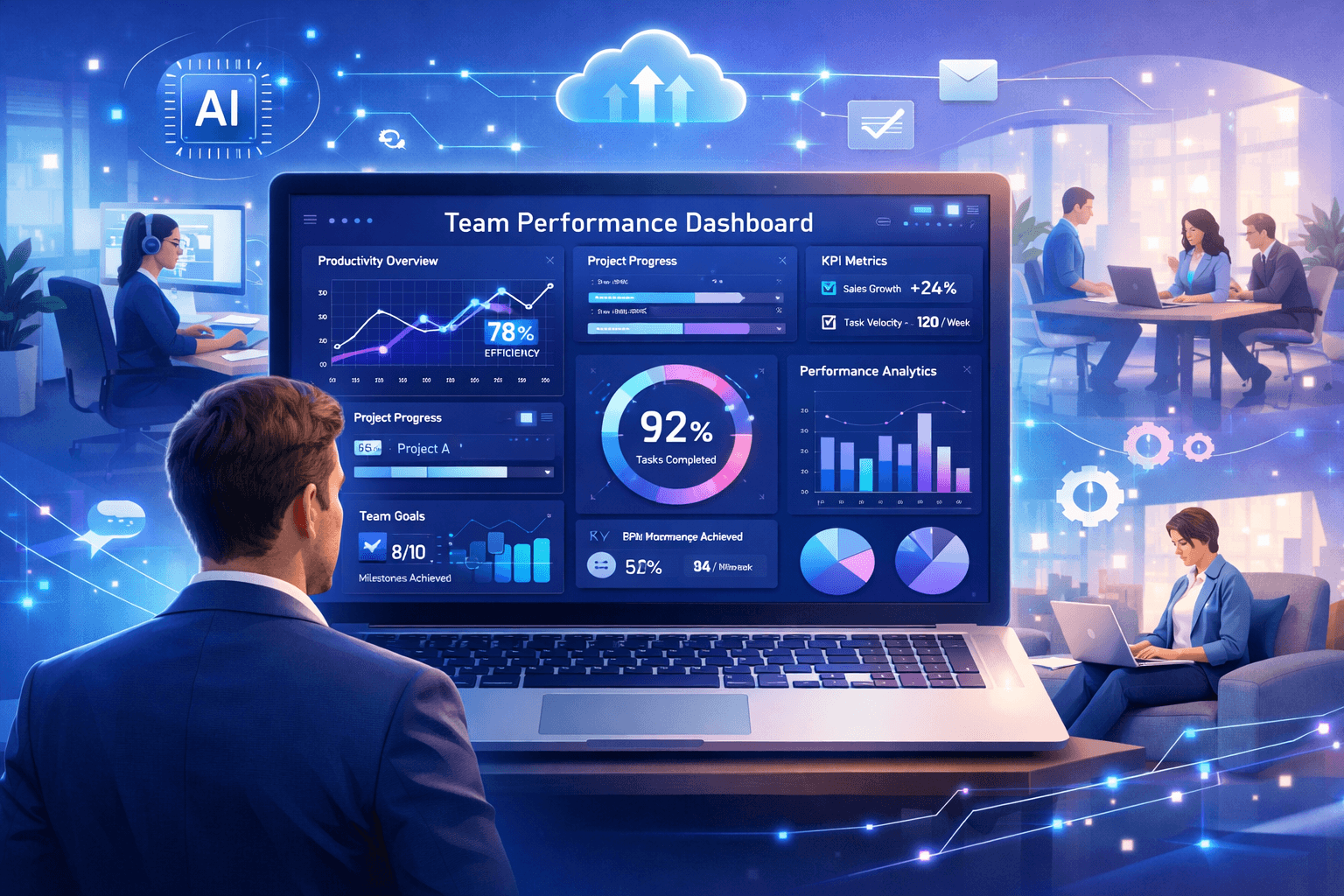
Platforms like Aktok bring these pillars together in a single connected workspace. Instead of updates coming in through messages, emails, and spreadsheets, all progress is captured and surfaced automatically. Managers can see which tasks are on track, which are at risk, and where support is needed, all from one Smart Performance Dashboard. This is not just a technical upgrade. It is a fundamentally different way of working that builds trust on both sides of the manager-team relationship.
Key Features of an Effective Performance Tracking System
A high-quality performance tracking setup goes well beyond a simple to-do list. The features below are the ones that make the biggest operational difference for service business teams.
• Smart Performance Dashboard: A real-time overview of all tasks, deadlines, and project status in one place. Managers see the big picture; teams see their priorities clearly.
• Automated Progress Updates: Task status updates automatically as work progresses, eliminating the need for manual reporting and reducing the burden on team members.
• Clear Task Ownership: Every task has one named owner, making accountability visible and removing the ambiguity that causes work to slip through the cracks.
• Alert-Based Management: Managers receive notifications only when something needs attention, a missed deadline, or a blocked task, rather than monitoring everything all the time.
• Performance Data and Reporting: Historical data shows how long tasks take, where work slows down, and how individual and team performance trends over time.
• Workload Visibility: Managers can see who is overloaded and who has capacity, enabling smarter work distribution and preventing burnout before it happens.
Benefits of Tracking Performance Without Micromanaging
Moving to a results-based, system-driven performance tracking model delivers measurable improvements for both managers and teams. The immediate benefit is time: managers stop spending hours collecting updates and attending status meetings, and team members stop preparing reports that take time away from the actual work. A well-designed project management system typically saves management teams eight to twelve hours per week in coordination overhead alone.
Beyond time savings, the quality of decisions improves significantly. When managers have access to accurate, real-time performance data, they can identify risks early, allocate resources proactively, and give feedback based on actual results rather than impressions. Teams benefit equally: clear expectations reduce anxiety, transparent progress builds confidence, and fair performance measurement based on deliverables rather than visibility increases job satisfaction and retention. Over time, this creates a high-trust culture where people take ownership because they know their work is seen and valued.
With Structure vs Without: Performance Tracking Comparison
The table below shows how the two approaches compare across the factors that matter most to managers and team members.
Factor | Without Structured Tracking | With Aktok Performance Dashboard |
Progress Visibility | Managers must ask for updates manually | Real-time dashboard shows status automatically |
Accountability | Unclear ownership, work falls through gaps | Named task owners with clear deadlines |
Problem Detection | Issues discovered after deadlines missed | Alerts flag risks before they escalate |
Team Morale | Employees feel watched and distrusted | Teams feel trusted and work independently |
Manager Time | 8–12 hrs/week on status updates | Under 1 hr/week on coordination overhead |
Performance Reviews | Based on opinions and visibility | Based on actual results and data |
Workload Balance | Invisible until burnout occurs | Visible in real time, manageable proactively |
Who Needs This: Roles That Benefit From Structured Performance Tracking
Structured performance tracking with a platform like Aktok is relevant across every management role in a professional services or agency environment. The specific benefits differ by role, but the common thread is access to the right information at the right time without having to interrupt the team to get it.
• Agency Owners and Founders: Get a real-time view of business health across all teams and projects. Make resource and hiring decisions based on actual utilization data rather than gut feel.
• Project Managers: See the full status of every project in one place, identify blockers early, and keep clients informed without chasing team members for updates.
• Department Heads: Monitor team performance across multiple projects without micromanaging individuals. Set clear KPIs and let the system surface exceptions.
• Operations Managers: Use workload data to distribute work evenly, prevent bottlenecks, and ensure consistent delivery quality across the team.
• HR and People Managers: Conduct performance reviews based on objective data. Identify top performers and team members who may need additional support before issues escalate.
How Aktok Helps You Track Team Performance Without Micromanaging
Aktok is an AI-powered business automation platform that brings CRM, Project Management, AI Chatbot, Live Chat, AI Sales Assistant, Appointment Scheduler, and Sales Tools into a single connected workspace. For performance tracking specifically, the platform's Smart Performance Dashboard gives managers a live view of every task, project, and team member's workload updated automatically as work progresses, with no manual reporting required.
When a task is created in Aktok, it is assigned to a named owner with a clear deadline. As work progresses, the system updates automatically. If a deadline is approaching and the task is not yet complete, an alert fires giving the manager the information they need without requiring a check-in. Workflow automation handles routine follow-ups and escalations, so nothing falls through the cracks. Performance data is captured continuously and available for reporting, making performance reviews faster, fairer, and grounded in actual results. Aktok is built for small and growing businesses — no IT team required, and teams are operational in minutes.
Case Study: How a Professional Services Firm Cut Manager Check-Ins by 70%
Background
A twelve-person digital marketing agency was struggling with a familiar problem: the three project managers were spending the majority of their week in status update meetings or individually chasing team members for progress reports. Deliverable quality was inconsistent because no one had a clear view of workload distribution, and two senior designers were consistently overloaded while others had available capacity. Client satisfaction scores were slipping.
After Implementing Aktok
The agency implemented Aktok's Project Management and Smart Performance Dashboard across all projects. Every task was assigned a named owner with a deadline. Progress updated automatically as work moved through stages. Project managers set up alerts for tasks approaching deadlines without completion, and the workload view immediately surfaced the distribution imbalance across the design team. Within the first month, status meetings were reduced from five per week to one. Check-ins dropped by 70%. Overdue tasks fell by 45% in the first quarter as workload was rebalanced using live utilization data. The project managers redirected the recovered time toward client strategy and new business development.
Check-in meetings reduced: 70% in month one
Overdue tasks reduced: 45% in Q1
Manager time recovered per week: 9 hours
Conclusion
Tracking team performance does not require constant check-ins, status meetings, or micromanagement. It requires the right system, one that captures progress automatically, surfaces risks before they become problems, and gives every team member clear ownership over their work. When that system is in place, managers gain the visibility they need, and teams gain the independence they need to perform at their best.
Aktok brings everything a professional services team needs Project Management, Smart Performance Dashboard, CRM, AI Sales Assistant, AI Chatbot, and workflow automation into one connected platform built for teams that want results without complexity. Stop managing through interruptions. Start managing through insight.
Frequently Asked Questions
1. What is the difference between performance tracking and micromanaging?
Performance tracking is about monitoring outcomes, completed tasks, met deadlines, and delivered results using systems that update automatically. Micromanaging is about monitoring activities, often in real time and through direct intervention. The key difference is that good performance tracking gives teams autonomy while keeping managers informed, whereas micromanaging removes autonomy and creates pressure that reduces both motivation and output quality.
2. How does automated progress tracking reduce manager workload?
Automated tracking tools update task status as work progresses, without anyone needing to submit a report or send an update manually. Managers can check the project management dashboard at any time and see exactly where each project stands. This eliminates status meetings, follow-up messages, and the time spent compiling updates from multiple sources, typically saving eight to twelve manager hours per week.
3. Can performance data replace annual performance reviews?
Performance data from a platform like Aktok does not replace reviews; it makes them significantly more useful. Instead of relying on a manager's memory or a few recent examples, reviews can be grounded in months of objective data showing task completion rates, on-time delivery, and workload contribution. This makes feedback fairer, more specific, and more useful for both the employee and the organization.
4. How does clear task ownership improve team performance?
When every task has one named owner, responsibility is unambiguous. Team members manage their own work better because they know they are accountable for specific outcomes. Issues get raised earlier because the owner knows they will be visible when the deadline approaches. Managers can direct questions and support to the right person rather than running group check-ins to find out who is responsible for what.
5. Is Aktok suitable for small teams that do not yet have a project management system?
Yes. Aktok is specifically designed for small and growing businesses. The platform requires no IT infrastructure, and teams can be onboarded and operational within a day. The project management module scales from a two-person team to a multi-department organization, and its pricing is designed for businesses in the early stages of building operational infrastructure.

For More Details
Aktok CRM is built specifically for small business teams who want powerful sales tools without the complexity of enterprise software.
For More Details