
Top Reasons Companies Are Shifting from Traditional Offices to Digital Workspaces
Introduction
The traditional office was built around a simple assumption that work happens best when everyone is in the same physical space, at the same time, using the same set of tools sitting on their desks.
That assumption held for decades. Then it started showing cracks.
The shift away from traditional offices did not begin with a single event. It started with the gradual recognition that physical proximity alone does not create productive teams that commutes waste time, that fixed office hours do not reflect how knowledge work actually gets done, and that the tools employees were being asked to use inside those offices were often more fragmented and inefficient than the situation required.
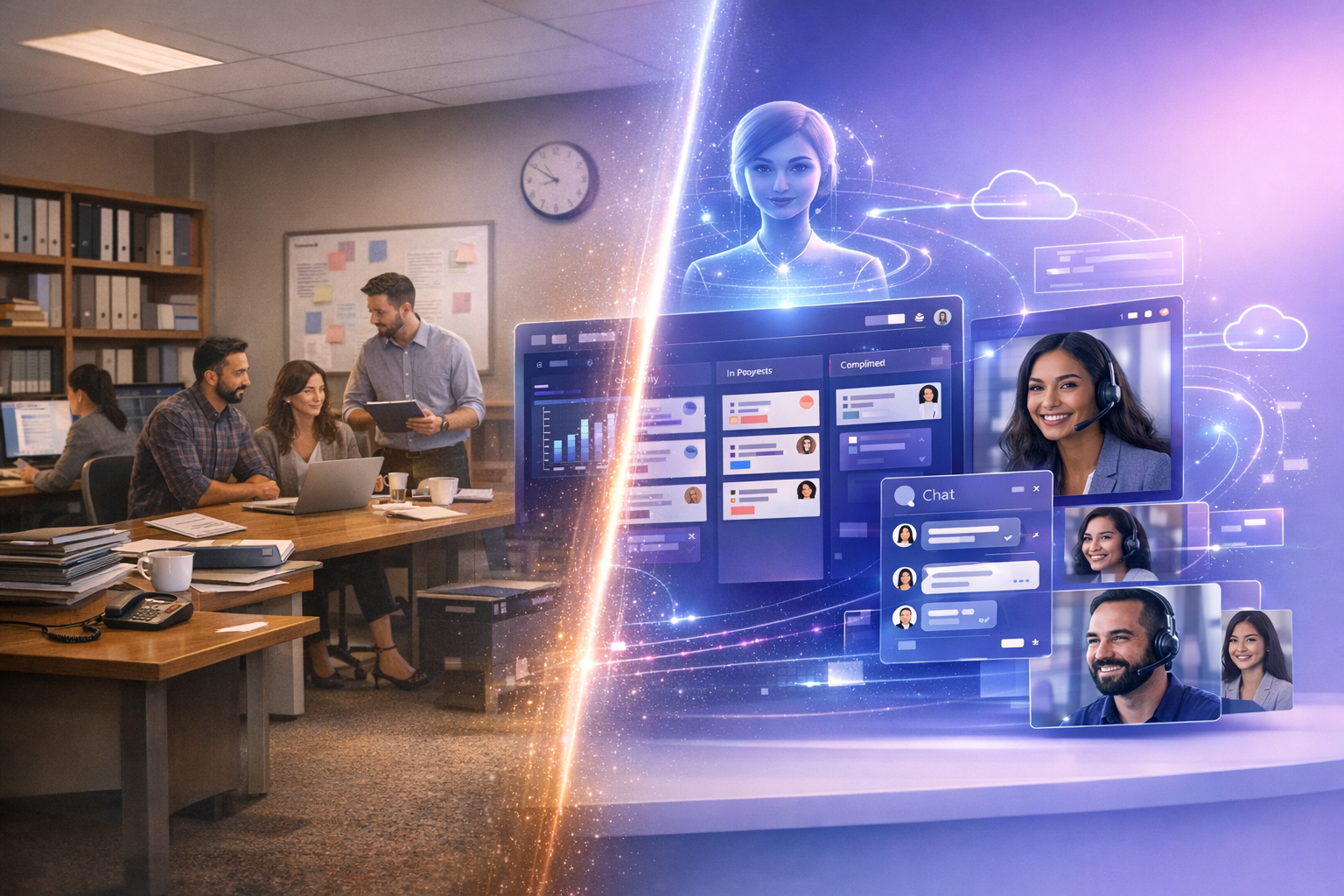
By 2026, the movement from traditional offices to digital workspaces has become one of the defining transitions in how businesses of all sizes operate. This is not a temporary adjustment. It is a structural change in what a workplace is, what it contains, and what it enables.
This article explains why companies are making this shift, what problems it solves, what a digital workspace actually provides, and how small businesses in particular can use platforms like Aktok to make the transition without sacrificing visibility, collaboration, or operational control.
Traditional Offices Were Never as Efficient as They Looked
For most businesses, the traditional office created an illusion of productivity. People were present, meetings were happening, the space was full. But presence is not the same as output, and busy is not the same as being effective.
The real inefficiencies of traditional office-based work ran deep and quietly.
Information lived in physical locations in filing cabinets, on specific computers, in the heads of people who happened to be in the office that day. If a key team member was out, work stalled. If a document was needed by someone working remotely or at a client site, the process of accessing it was slow and unreliable.
Communication happened in meetings that could have been messages, and in messages that could have been documented decisions stored somewhere searchable. The cost of running recurring status meetings, booking rooms, gathering the right people, aligning on what was discussed was invisible because it was simply accepted as how work worked.
Technology was installed by location rather than by need. If you wanted access to the company's CRM or project management tool, you needed to be on the right network, on the right device, in the right building. Remote access was a workaround, not a design feature.
Scaling the team meant scaling the space more desks, more meeting rooms, more square footage, more overhead. Growth had a physical cost that had nothing to do with the actual work being done.
For small businesses specifically, these inefficiencies were amplified by small team size. When you have five or ten people, the cost of a slow information environment, a missed follow-up, or an hour of coordination that should have taken five minutes is proportionally far larger than it is in an enterprise with dedicated support teams and administrative infrastructure.
Digital Workspaces Replace Location with Connection
A digital workspace does not simply replicate the office online. It redesigns how work is organised, communicated, and executed with connection and data at the centre rather than physical presence.
In a digital workspace, the work environment is a platform. Tasks, client records, project timelines, team conversations, customer-facing chat, scheduling, and AI tools all exist in one connected system. Work does not happen in a location, it happens in a shared digital environment that every authorised team member can access from anywhere, at any time, on any device.
The shift this creates is fundamental. Information is no longer stored by location, it is stored by context. A client's full history, every conversation, every task related to their account, every deal note, is accessible to anyone on the team who needs it, immediately, without asking someone else to forward an email or check a shared drive.
Collaboration is no longer dependent on being in the same room. It is built into the structure of how work is organised, tasks have owners, projects have timelines, updates are visible to the whole team in real time.
And the cost structure of running a business changes. The overhead of physical space rent, utilities, equipment can be reduced or eliminated without a corresponding reduction in operational capability. For small businesses, this is often the difference between reinvesting in growth and absorbing fixed costs that produce no return.
Key Features of a Modern Digital Workspace
Not every tool that markets itself as a digital workspace solution delivers the depth that genuine operational transformation requires. The platforms driving the shift from traditional offices in 2026 share a consistent set of capabilities.
Centralised project and task management gives every team member visibility into what is happening, who owns what, and what is due without a status meeting to communicate it. Work is visible by default rather than visible on request.
An integrated CRM connects client relationships, deal history, and communication directly to the work being done for those clients. Sales and delivery are not managed in separate systems; they are part of the same operational environment.
Real-time and asynchronous communication tools replace the need for physical proximity as the organising principle of collaboration. Team members can work independently while staying aligned on priorities and progress through structured, documented communication.
Customer-facing tools live chat, AI chatbot, appointment scheduling connect directly to the backend workspace so that every client interaction is captured, contextualised, and accessible to the team without manual transfer.
AI capabilities that work on actual business data not just generic content generation give small teams leverage that was previously available only to much larger organisations. Querying your CRM through a conversation, surfacing overdue tasks automatically, or getting a real-time picture of pipeline health through an AI assistant represents a qualitative change in how quickly a small team can stay on top of a complex operation.
Why Aktok Is Built for This Shift
For small businesses making the transition from a traditional office environment to a digital workspace, Aktok is the platform specifically built for that move.
Aktok brings together every component of a functioning digital workplace CRM, project management, AI Sales Assistant, live chat, AI chatbot, appointment scheduling, and sales tools in one connected platform. There is no integration layer to maintain, no data sync to manage, and no separate subscriptions to coordinate. Every part of your business operation runs inside a single environment where data flows automatically between functions.
When a deal closes in the Aktok CRM, project delivery begins on the same platform. When a client books an appointment through the Aktok scheduler, the record appears in the CRM without manual entry. When a website visitor chats with the Aktok AI chatbot, that conversation is linked to the contact record and available to the whole team immediately.
Aktok also includes AI Agent Access, which allows AI assistants to connect directly to your workspace data and take action through plain language conversation. Small business owners can ask their AI "which deals are overdue for follow-up," "what tasks are pending on the Harris account," or "update this contact's record" and get live results from their actual Aktok data. This is the kind of operational AI capability that eliminates the manual coordination work that traditional office environments accept as unavoidable overhead.
Aktok is priced and designed for small business teams, no IT department required, no long implementation timeline, and no enterprise contract. Teams can be fully operational on Aktok within days of signing up.
The Benefits of Making the Shift to a Digital Workspace
Companies that have made the transition from traditional offices to digital workspaces report consistent, measurable improvements across three areas.
Operational efficiency improves because information is accessible without manual effort, tasks have clear owners and deadlines, and the coordination overhead of running status meetings and chasing updates drops significantly. Teams do more in less time not because they are working harder but because the systems around them are working better.
Business resilience increases because the digital workspace is not dependent on any single location, device, or team member being available. Work continues smoothly when someone is travelling, working from home, or unavailable because everything they know about their accounts and projects is documented in the shared workspace rather than stored in their head or on their local machine.
Cost structures become more flexible. Without a fixed physical space as the anchor of operations, small businesses can make decisions about office space based on genuine need rather than operational necessity. Some eliminate the office entirely. Others reduce it to a smaller collaborative space used occasionally. Both paths free up a budget that can go toward growth instead of overhead.
Who Benefits Most from the Shift to Digital Workspaces
The move from traditional offices to digital workspaces delivers the highest impact for specific types of businesses and roles.
Small business owners and founders managing both client relationships and internal operations simultaneously benefit most from the unified visibility a digital workspace provides. Instead of switching between a CRM, a project board, a scheduling tool, and a chat platform, they manage everything from one environment.
Consultants and service-based businesses that work directly with clients across multiple accounts benefit from the ability to keep client context, project status, and communication history in one accessible place without a physical office as the anchor of client information.
Sales and account management teams benefit from CRM and pipeline tools that are connected to project delivery, so nothing is lost in the handoff from sale to service.
Remote and hybrid teams benefit from a workspace that is designed for distributed work at its core not adapted from an office-first model as an afterthought.
Growing businesses are approaching the point where managing operations across separate tools is becoming an unsustainable benefit from adopting a connected digital workplace before the complexity of too many disconnected systems becomes a structural problem.
Conclusion
The shift from traditional offices to digital workspaces is not driven by a single trend or a single technology. It is the result of businesses recognising, often through direct operational experience, that physical presence is not the same as productivity and that the right platform can deliver more visibility, more efficiency, and more flexibility than a traditional office ever could.
In 2026, the question for most small businesses is not whether to make this shift. It is which platform to make it with. The answer is the one that connects every part of how your business runs; sales, delivery, client communication, and AI tools in a single environment that works the way your team actually works.
For small business teams, that platform is Aktok.
Make the Shift to a Digital Workspace with Aktok: Start Free Today
Aktok Workspace gives small business teams everything they need to run their operations digitally, CRM, project management, AI Sales Assistant, live chat, AI chatbot, appointment scheduling, and AI Agent Access all in one connected platform.
No technical setup. No long onboarding.
Start your free trial and see what your business looks like when everything runs from one place.

Looking for a digital workspace platform?
Aktok brings together project management, CRM, AI automation, live chat, and team collaboration in one connected digital workspace platform
Start your free trial today