
Why Organizations Need CRM Software
Introduction
Every business runs on relationships. Whether you are closing a new deal, resolving a customer complaint, or nurturing a long-term client, the quality of those relationships determines how far your business grows. Yet for most organizations — especially small and mid-sized ones managing customer relationships still happens through scattered spreadsheets, overflowing email inboxes, and verbal handoffs that get forgotten by Monday morning.
This is where CRM software changes everything.
Customer relationship management software is not just a contact book or a sales tracker. It is the operational backbone of how your team acquires, manages, and retains customers at scale. Organizations that invest in the right CRM system do not just organize data better they build stronger pipelines, close deals faster, and create customer experiences that generate loyalty and referrals.
This article explains the real reasons why every organization from startups to established businesses needs CRM software, and what happens when they finally adopt one.
The Problem: Managing Customer Relationships Without a System
Most businesses reach a breaking point. In the early days, a founder can remember every client conversation, every follow-up, and every deal in progress. But as the team grows, leads multiply, and customers expect personalized service at speed, that informal approach collapses.
Here is what unmanaged customer relationships actually look like in practice:
Leads fall through the cracks.
A prospect fills out a form on your website. It lands in someone's inbox, gets buried under other emails, and never receives a response. That lead which could have been a paying customer moves on to a competitor.
Sales teams operate blind.
Without a shared system, every salesperson maintains their own notes and follow-up habits. When someone leaves the company or goes on leave, their customer history leaves with them.
Customer data lives in silos.
Marketing has one set of contact records. Sales has another. Support has a third. None of them talk to each other. The result is customers receiving duplicate messages, inconsistent information, and a frustrating experience that erodes trust.
Follow-ups are reactive, not strategic.
Without visibility into the sales pipeline, teams respond to whoever shouts loudest rather than nurturing the leads most likely to convert.
Reporting is guesswork.
Managers ask for a revenue forecast and spend hours manually pulling data from multiple sources only to produce a number they cannot fully trust.
These are not signs of a lazy team. They are symptoms of a system problem. And CRM software is the solution.
The Solution: What CRM Software Actually Does
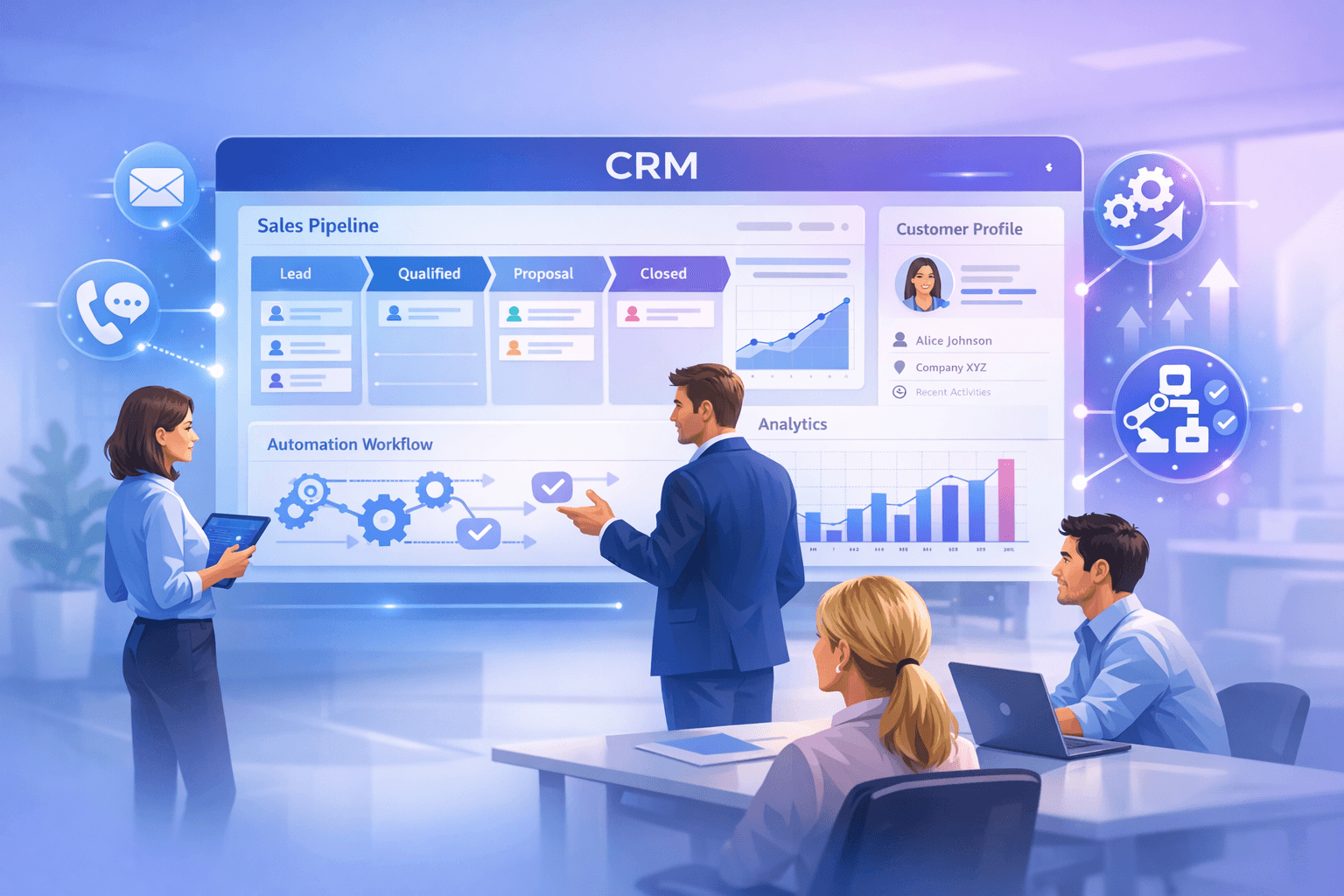
CRM software centralizes every customer interaction, sales activity, and business relationship into one connected platform. Instead of chasing information across different tools, your entire team operates from a single source of truth.
At its core, a customer relationship management platform captures every touchpoint a customer has with your business from the first website visit to the signed contract and beyond. It gives sales, marketing, and support teams shared visibility into who the customer is, what they need, and where they are in their journey.
The best CRM systems go further by automating repetitive tasks, scoring leads based on behavior, forecasting revenue based on pipeline data, and connecting seamlessly with other tools your team already uses ike AI chatbot, live chat, and project management tools.
When everything is connected and visible, your organization stops reacting to customers and starts building proactive, intelligent relationships with them.
Key CRM Features That Drive Results
Not all CRM software is built the same. The features that matter most are the ones that remove friction from your sales process and give your team the clarity to act quickly.
Contact and Company Management
A good CRM stores complete customer profiles including contact details, company information, communication history, website engagement, and email interactions. Instead of piecing together a customer's background from memory, your team has the full picture instantly.
Sales Pipeline Management
Visualize every deal in your pipeline using customizable board or list views. Segment leads into smart groups and move opportunities through stages that match your real sales process. With a clear sales pipeline, no deal gets lost and every opportunity gets the attention it deserves.
Sales Automation
Repetitive tasks like follow-up emails, status updates, lead assignments, and data entry consume hours your team could spend actually selling. Sales automation handles these tasks automatically, so your salespeople stay focused on conversations that close deals.
Lead Scoring
Not every lead is ready to buy. Lead scoring ranks prospects based on their behavior, engagement level, and demographic fit helping your sales team prioritize the right opportunities and stop wasting time on leads that are not yet ready.
Sales Forecasting
Predict future revenue based on historical data and current pipeline health. Reliable sales forecasting helps managers plan resources, set targets, and spot risks before they become missed quarters.
CRM Integrations
A CRM that works in isolation is only half useful. The most valuable CRM software integrates with your business automation platform, AI chatbot, live chat, appointment scheduler, and project management tools so data flows seamlessly across every customer-facing function.
Mobile CRM
Sales does not stop when your team leaves the office. Mobile access means salespeople can update records, respond to leads, and manage deals from anywhere keeping the pipeline moving even on the go.
Benefits of Using CRM Software
The benefits of CRM software are not abstract they show up directly in your revenue, team efficiency, and customer satisfaction scores.
Higher conversion rates.
When leads are captured, scored, and followed up systematically, fewer opportunities are missed. Organizations using structured sales automation consistently report improved lead-to-customer conversion rates.
Faster deal cycles.
With full context at their fingertips and automated follow-ups taking care of routine touchpoints, sales teams spend less time on admin and more time advancing deals toward a close.
Better customer retention.
Customer relationship management is not just about acquiring new clients it is about keeping the ones you have. CRM data helps teams spot at-risk accounts early, trigger proactive outreach, and deliver personalized service that builds loyalty.
Smarter marketing alignment.
When marketing and sales share the same CRM system, campaigns target the right people, lead quality improves, and both teams measure success with the same data.
Real-time visibility for leadership.
Managers no longer need to chase updates or wait for weekly reports. Dashboards show live pipeline health, team performance, and revenue progress — enabling faster and more confident decisions.
Organizational memory that outlasts individuals.
When a key salesperson moves on, their customer relationships do not have to leave with them. Every conversation, deal note, and client preference stays in the CRM system, fully accessible to whoever takes over.
Who Needs CRM Software? Roles That Benefit Most
CRM software is often associated with sales teams, but its value extends across every customer-facing function in an organization.
Sales Teams use CRM to manage their pipelines, track deals, automate follow-ups, and close revenue faster. With lead scoring and sales forecasting, they prioritize intelligently and hit targets more consistently.
Marketing Teams use CRM data to understand their audience, personalize campaigns, and measure which channels actually drive qualified leads. When marketing and sales share a CRM system, lead handoffs become smoother and campaigns become more effective.
Customer Support Teams use CRM to access the full history of every customer interaction, so they can resolve issues faster, avoid asking customers to repeat themselves, and deliver service that feels genuinely attentive.
Business Owners and Founders use CRM dashboards to maintain visibility over growth metrics without getting pulled into day-to-day detail. Revenue forecasts, pipeline health, and team performance are all visible at a glance.
Operations and HR Teams increasingly rely on CRM integrations to connect customer data with internal workflows improving everything from onboarding new clients to managing service delivery timelines inside project management tools.
In short, any organization that has customers, which is every organization needs CRM software.
Why Modern Businesses Rely on CRM Systems to Scale
Managing customer relationships through informal methods works until it does not. The moment your business starts to scale, the cracks appear: missed follow-ups, lost deals, inconsistent service, and a sales team operating without shared visibility.
CRM software addresses these problems at the root. It gives your entire organization a unified, intelligent system for managing every customer touchpoint from first contact to long-term retention. It automates repetitive work, surfaces the right insights, and connects your sales, marketing, and support functions around a shared understanding of every customer.
The organizations that grow consistently are not the ones working harder. They are the ones working inside better systems.
Ready to See What a CRM Can Do for Your Business?
Aktok CRM is free CRM software built specifically for small businesses and growing teams. It brings together contact management, customizable sales pipeline views, lead scoring, sales automation, sales forecasting, and mobile access all in one connected business automation platform alongside AI chatbot, live chat, appointment scheduler, and project management tools.

For More Details
Aktok CRM is built specifically for small business teams who want powerful sales tools without the complexity of enterprise software.
For More Details